
Re:View - Tom Stoppard's Rosencrantz and Guildenstern are Dead (1990)

En Garde, dear reader, for the verbal duelling commenceth now!
It took over 20 years to make Rosencrantz and Guildenstern are Dead. But not in the way you think I mean. In fact, I mean that from the moment of the original stage play’s production rights being snatched up by MGM in 1968, to the movie’s release in 1990, over 20 years had passed. Nevertheless, you’d be entirely forgiven for being confused, since I gave no actual indicator of when those 20 years started and when they ended. Perhaps I meant the production schedule itself lasted for 20 years, and that Tim Roth and Gary Oldman were simply cast in the movie as toddlers, Tom Stoppard having had a stunningly accurate premonition of the future that they were to be the perfect leads, even before they were old enough to know who Rosencrantz or Guildenstern were. Maybe from the instant that Stoppard conceived of the play, to a second-hand copy of its 25th anniversary DVD winding its way into my amazon basket, since, before that time, I had neither heard of the play nor the movie, so to me, the whole enterprise might as well have never existed until that chance purchase. But why does that even matter? After all, I am only one viewer, and phenomena such as plays written by and movies directed by Czech-British émigrés like Tom Stoppard must surely be outside of my immediate experience, as things do not miraculously manifest themselves upon my discovering them.
I’m well aware that you are most likely becoming restless and frustrated at this point, completely baffled as to why I’m aimlessly playing at the polysemy of my opening line. If this is your prevailing mood, you will in all likelihood not enjoy this movie. That whole paragraph was in truth a pretty limp pastiche of the movie’s writing. Stoppard’s story orbits almost entirely around these linguistic games, where each line of dialogue never seems to fully respond to the one preceding it, always suggesting, hinting at a grander meaning, eliding a sequitur left unsaid, tangentially spilling out into apparently accidental profundity. This is a talking-heavy script, so if the thought of meaty stichomythia on the nature of reality already makes your eyelids feel heavy, it’s safe to give this one a miss. For those still intrigued, let me then extend my hand, and offer you a seat, as I explain why I think this film is an underrated classic.
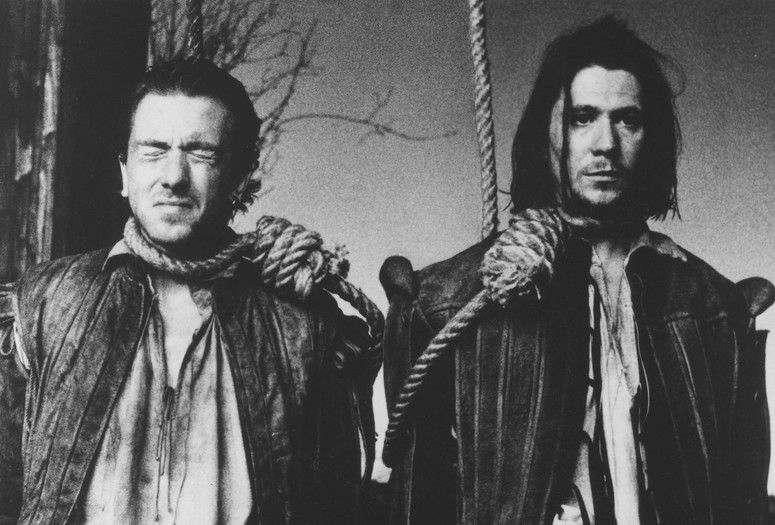
Bob Dylan once said, "He who ain't busy livin' is busy dyin'". Little did we know he was actually talking about these hapless bozos from Hamlet.
Any condescending cultural connoisseur worth his salt knows Shakespeare’s Hamlet. Even your average joe (mama) probably knows the story, albeit loosely perhaps. Moody prince is moody because his mum has just slipped into bed with his uncle less than a month after his dad died. A speedy rebound to be sure. Spooky visit from beyond the grave, moody prince resolves to kill his mum-shagging uncle, the new king, after his ghost dad reveals that he was poisoned by the former. So, he kills the uncle and that’s the end of it.
…But of course it isn’t that straightforward. Because this is Shakespeare, we have to wade through a lifetime’s worth of courtly drama, feigning madness, piracy on the high seas, and manslaughter to arrive at a rip-roaring action-packed climax where no one’s clothes remain unsaturated with either blood or poison.
Two extremely minor characters one might remember from one’s schooldays spent studying the play were Hamlet’s uni mates Rosencrantz and Guildenstern, sent for by the mum-shagging uncle king and his new bride to try and stop moody prince Hamlet from being moody. To be fair, if I were his mum, I’d get pretty fed up with all his navel-gazing too. What Rosencrantz and Guildenstern are Dead does is to tell the events of Hamlet entirely from the viewpoint of these two individuals who are not involved in the vast majority of events. In the text itself, they only really appear in two scenes. In choosing to centre the script around people relatively insignificant to the plot and structure we all know, Stoppard reimagines and revitalises our notion of theatre, and more broadly, tragedy.

A touch of Jean-Paul Belmondo, perhaps, as the author lights a cigarette.
As mentioned previously, this is a movie that lives and dies by its wordplay, inheriting the Shakespearean mould of witty repartee and subtext-ridden meditation cohabiting. The film betrays its theatrical ancestry in these drawn-out conversations, whose cinematographic portrayal doesn’t do a whole lot to spice up the action visually. Yet this matters not, for the dialogue itself crackles with fire, comedy, depth, and curiosity. Stoppard is a gifted wordsmith; his emulation of and deviation from the Shakespearean style leads to some truly inspired lines.
These are elevated to an even higher stature through the performances. Tim Roth is excellent as the cynical, bitter pedant Guildenstern, playing the straight man to Gary Oldman’s more languid, open-hearted, naïve, sometimes brilliant Rosencrantz. Their chemistry is undeniable; to watch these two legendary actors in a much smaller film playing off of each other in a vaguely buddy-cop dynamic is a real treat.

Guildenstern's inadvertent discovery of Newton's cradle - some wonderful comic acting makes this scene among the best in the film.
Much of the comedy stems from reworking the scenes of Hamlet, shown in snippets, as Ros and Guild watch on from the sidelines. For example, Polonius is only killed by Hamlet through the curtains because the two protagonists jump him, causing him to scream for help, only to be mistaken for an intruder by Hamlet. Ros and Guild take on the role of the theatrical audience observing the drama, and debating between each other their role within it. This plays into Stoppard’s commentary on theatre and dramatic observation and irony which exists as an undercurrent throughout the narrative.
The concept of the theatre (and by extent, the Tragic with a capital T) is embodied in the Player, or Player King, brought to life with a wry glee by Richard Dreyfuss, the director of a group of touring actors whose visit to the palace coincides with that of our two ‘heroes’. These are the same players who perform The Murder of Gonzago to Claudius in the play’s latter half. The Player hounds our protagonists throughout the picture, always tailed by his company, who function as a kind of Greek Chorus in the story. Surrounding him is a pervasive foreboding atmosphere; we as an audience never feel at ease around him, and The Player carries with his presence an element of the supernatural. The editing becomes more warped, cuts don’t share much continuity, and the sound design shifts into an off-kilter mood.
Considering this is his only ever feature film as director, Stoppard must receive credit for this very sophisticated understanding of the formal language of film; when to follow the rules and when to break them. In his own words, he directed the film himself, as “It just seemed that I'd be the only person who could treat the play with the necessary disrespect." I could say that the film unsuccessfully tries to hide its origins on stage, yet I would wholeheartedly disagree with the criticism that this material ‘does not belong’ on screen.

Anyone for tennis?
Stoppard relishes giving the scenery and his characters time to breathe, allowing for extended periods of silence where nothing is said at all. In these moments Stoppard capitalises on his stunning practical sets (the film was shot almost entirely in Trogir, Croatia), and ‘cinematises’, if you like, the source material, shilling out the “appropriate disrespect”. Seemingly endless stretches of ambient background noise neighbour equally interminable conversations about death or memory. On their own, these styles would make for two incredibly boring flicks, yet their combination forges a wildly unique cinematic aesthetic.
As much as Rosencrantz and Guildenstern are Dead tries to mark itself out as cinema, it’s still occupied with the theatre, and all that that entails: drama and tragedy being the most overt. Stoppard delights in showing the audience impromptu plays, creating an homage to the very origins of the form in which we are experiencing this version of the narrative.
The play itself is a marquee production, and continues to enjoy popularity, attracting big names like Dr. Strange, not quite such big names like Tim Minchin, and little names like Harry Potter (can you believe he's only 5'5"?!).
These are all wordless pieces, performed by the Player and his company either to the peasant servants in the castle, or privately to rehearse. The ingenuity of their physicality is extraordinary, reminiscent of work by Kneehigh, or Complicité. Choppy waves on the ocean are represented with rolling bodies that shoot up their arms, fingers splayed become the foamy spray. Blood a red ribbon tied onto the sleeve. A theatrical performance within the theatrical performance of The Murder of Gonzago within the movie which is set within the story of Hamlet, which exists within our own lives (perhaps an extension of the theatre), is represented as a puppet show.

'Hey Gary, isn't that the scientist bloke from Jaws?' 'Come off it, Tim, pull the other one.'
The reverse edge of this sword of quality live performance is that it represents the movie’s primary flaw. If you aren’t aware at all of the tropes and context that inform Hamlet on a literary level, or somewhat clued up on certain concepts of ancient Greek tragedy, without much care the art of drama and the philosophy of the actor, then this will be a confusing mess to you. The film pours all of its efforts into these intertextual thematic webs, so to someone whose interests lie elsewhere, this will probably be one of the most pretentious movies they'll ever see. Outside of these themes, the story doesn’t really work by itself, so to call this movie universally accessible would be a bit of a joke, in all honesty. Though if you fancy yourself able to approach my genius intellect, you should have no issue whatsoever.
Rosencrantz and Guildenstern are everymen, and Stoppard makes a deliberate decision to shine a light on the tragedy of the majority. Not everyone can be a Hamlet. It takes a certain main character syndrome to be that moody; self-pity as an olympic sport is reserved only for the protagonists of the universe 💅. The movie builds to a conclusion foreshadowed from the first frame, culminating in a denouement both bittersweet and thought-provoking. Art is Life, and Life is Art, insists Stoppard. It’s left up to the audience to contemplate that idea and all of its permutations for themselves. For its nuance, refined sensibility and deft craftsmanship, Rosencrantz and Guildenstern are Dead riffs the Shakespeare classic with witty panache, yet concurrently manages to leave room for serious philosophical contemplation. It comes with a strong recommendation for any aspiring actors and playwrights. As sacrilegious as it may be to go for the movie rather than the play, this is unmissable stuff.


Comments